
North Richland Hills Wood Flooring installs wide plank and pattern wood flooring in North Richland Hills, TX and the surrounding cities including Watauga, Hurst, Haltom City, Colleyville and Bedford. These are the floors people choose from a photograph, and they are the least forgiving to install, because both wide boards and pattern layouts amplify every deviation in the surface underneath them.
That is the honest framing of this service. A straight-laid narrow strip floor absorbs a small amount of subfloor imperfection along its length and hides it. A herringbone field locks in two directions and reports a high spot as a joint that steps; a seven inch plank turns a seasonal humidity swing that a strip floor would never show into a visible line. The look is worth having and it costs preparation.
So the sequence on these jobs runs backward from the way they get sold. We start with the slab classification and the moisture reading, then flatness, then the layout set-out, and only then the board itself. Wood acclimates inside the house in the room it is going into, never in the garage, because a wide board that arrives at the wrong moisture content moves after installation rather than before it.
How Wide Is Too Wide
Seasonal Movement Across the Width
Wood moves across the grain, so movement scales with board width. The same seasonal change in indoor humidity that a two and a quarter inch strip absorbs invisibly shows on a seven inch plank as a real gap in winter and tight joints in summer. Equilibrium moisture content is the number that governs it, and controlling indoor humidity is what keeps the swing small.
Engineered Construction and Wide Boards
A cross-laminated core restrains movement across the width, which is precisely why most wide plank on the market is engineered. It also allows a wide board over a slab where a solid one would be a poor idea. The trade is the wear layer: six millimeters keeps several refinishes available, three millimeters usually one, and two millimeters none at all.
Solid Wide Plank and What It Asks of a Room
Solid wide plank is achievable and it makes demands. It wants a nailable deck, a house whose humidity is genuinely controlled year-round, and an owner who accepts seasonal gapping as normal behavior rather than a defect. We say all three out loud before quoting it, because selling the look without the conditions is how a beautiful floor turns into an argument in February.
Herringbone, Chevron and Pattern Layouts
Herringbone Against Chevron
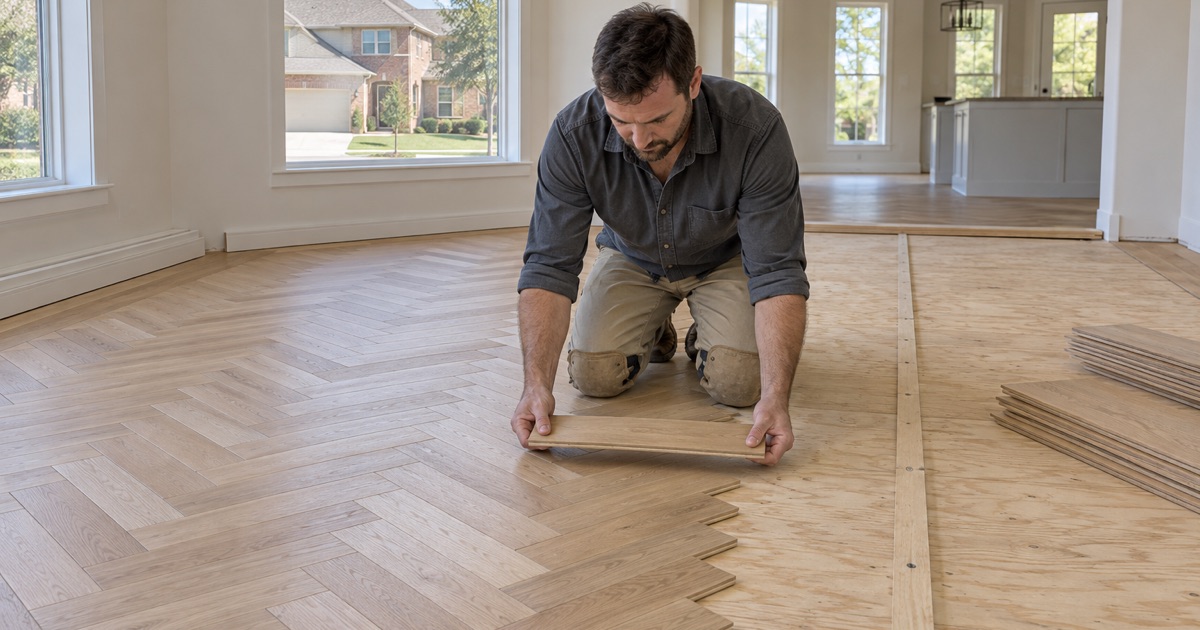
Herringbone sets square-ended rectangles at ninety degrees so the end of one board meets the side of the next in a staggered zigzag. Chevron miters both ends so the points meet in an unbroken V down the length of the room. Chevron costs more in both material and labor, because every board is cut twice and a fractional error in the angle accumulates across the field.
Setting Out the Pattern
A pattern floor is laid out from a center line established for the room, not from a wall, because walls in a real house are rarely parallel and never exactly square. Getting the set-out wrong pushes the error into the perimeter, where it shows as a tapering cut against the base. We snap and dry-lay the first runs before anything is bonded down.
Borders, Feature Fields and Transitions
A border frames a pattern field and gives the perimeter cuts somewhere to resolve, which is often what makes a herringbone room look finished rather than trimmed. Feature fields, medallions and changes of direction between rooms all need their transitions designed rather than discovered. We draw them at the estimate so the material order reflects the actual layout.
What a Pattern Floor Will Not Forgive
Flatness Before Pattern
Every pattern job starts with a straightedge across the field in both directions and every high and low marked on the deck. Ridges get ground, dips get filled with self-leveling underlayment, and burnished concrete is abraded so an adhesive can key into it. This work is invisible in the finished floor and it is the difference between a flat pattern and a rippled one.
Adhesive and Fastening Over a Slab
Pattern layouts favor a full-spread glue-down because the bond restrains pieces that a straight run would hold by sheer length. Over a post-tension slab nothing gets fastened at all, so glue-down or a floating system is the whole choice. Over a conventionally reinforced slab a sleeper or floating plywood deck brings nail-down installation back into play.
Expansion Gaps on a Wide or Patterned Field
Expansion allowance is sized to the total width of the field, so a wide plank or pattern floor across a large open plan needs more perimeter room than the same footprint in narrow strip. It goes at every wall, column and vertical obstruction, and base and shoe cover it entirely. Consuming that gap is what produces buckling in a humid month.
Choosing Species and Surface
White Oak, Hickory and Grade Character
White oak at 1360 Janka is the default for wide plank because it takes gray, natural and washed tones cleanly and its grain reads well at width. Hickory at 1820 Janka resists denting and brings strong color variation that a wide board displays rather than hides. Grade is a real decision here: character grade shows knots and mineral streak that a narrow strip floor would break up.
Wire-Brushed and Hand-Scraped on Wide Boards
Texture works harder on a wide board because there is more surface to catch light. A wire-brushed face opens the soft early wood and hides fine scratches; hand-scraped adds deeper undulation and hides more. Both are permanent decisions in one direction only, since sanding a textured wide plank flat removes the texture and cannot put it back.
Joining a Wide Field to Existing Narrow Strip
Width is the first thing the eye registers, so a wide plank field and an existing narrow strip floor will not read as one installation whatever the stain does. The good answer is a deliberate junction: a threshold at a doorway, a border where the two meet in the open, or a change of level handled with a reducer. We design that seam rather than letting it happen at the last board.
- 20+ Years Experience
- Dustless Containment
- Free Written Estimates