
North Richland Hills Wood Flooring repairs water damaged hardwood floors in North Richland Hills, TX and the surrounding cities including Watauga, Hurst, Haltom City, Colleyville and Bedford, and after 20 years of these jobs we treat the first visit as evidence gathering as much as estimating. A water loss is decided on what was recorded in the first days, and a floor is usually the largest line item in it.
So we document room by room: photographs before anything is moved, dated moisture readings from the boards and independently from the subfloor beneath them, and a line-of-sight map showing exactly where the flooring runs continuously from the wet area into rooms that are still dry. That map exists because continuous flooring and line of sight decide how far a replacement legitimately reaches, and it is much easier to establish before the tear-out than to argue afterward.
The second thing we do is slow down. A cupped floor is a floor with moisture still reaching its underside, and sanding it flat at that moment guarantees crowning later. Wood often recovers a surprising amount of its shape once the source is repaired and the assembly is genuinely dry. We meter until the readings stabilize, and only then price the sand, the board replacement or the replacement of the field.
The First Days After a Loss
Stop the Source, Then Record It
The water gets stopped first and photographed second, before rugs, furniture or boards move. A photograph of the room as it was cannot be recreated once the space has been cleared. We add dated readings from the same visit, so the file carries both what the room looked like and what the wood and subfloor actually measured on that day.
Mitigation and Who Is Expected to Do It
Policies expect a homeowner to take reasonable steps to limit further damage, and failing to is one of the few ways a covered loss becomes a disputed one. Getting standing water off, lifting soaked rugs and getting air moving all count. On a significant loss the drying itself belongs to a restoration contractor with the right equipment, and we work alongside that rather than pretending to replace it.
What Not to Say Early
Early statements are hard to walk back. Describing a leak as something you had noticed for a while, or guessing at how long it had been going, can reframe the loss as a gradual one before anyone has looked at the evidence. Stick to what you observed and when. We describe what the readings and the staining patterns physically show, and we leave the coverage conclusion to the people whose decision it is.
What the Floor Is Doing While It Dries
Cupping, Crowning and Buckling After a Loss
Cupping raises board edges above their centers because the underside is wetter than the surface. Crowning is what you get when a cupped floor is sanded flat before it dries. Buckling is the floor lifting off the subfloor entirely, which usually means the expansion gap was consumed. Each tells you something different about where the water went and how much of the floor is genuinely lost.
Metering the Subfloor, Not Just the Boards
A floor can read acceptably at the surface while the subfloor under it is still saturated, which is why a single top-side reading is not a drying verdict. We read through to the substrate, and on a slab we read the concrete itself. Rebuilding over a wet subfloor reproduces the original failure on a schedule nobody can see coming.
Which Boards Can Actually Be Saved
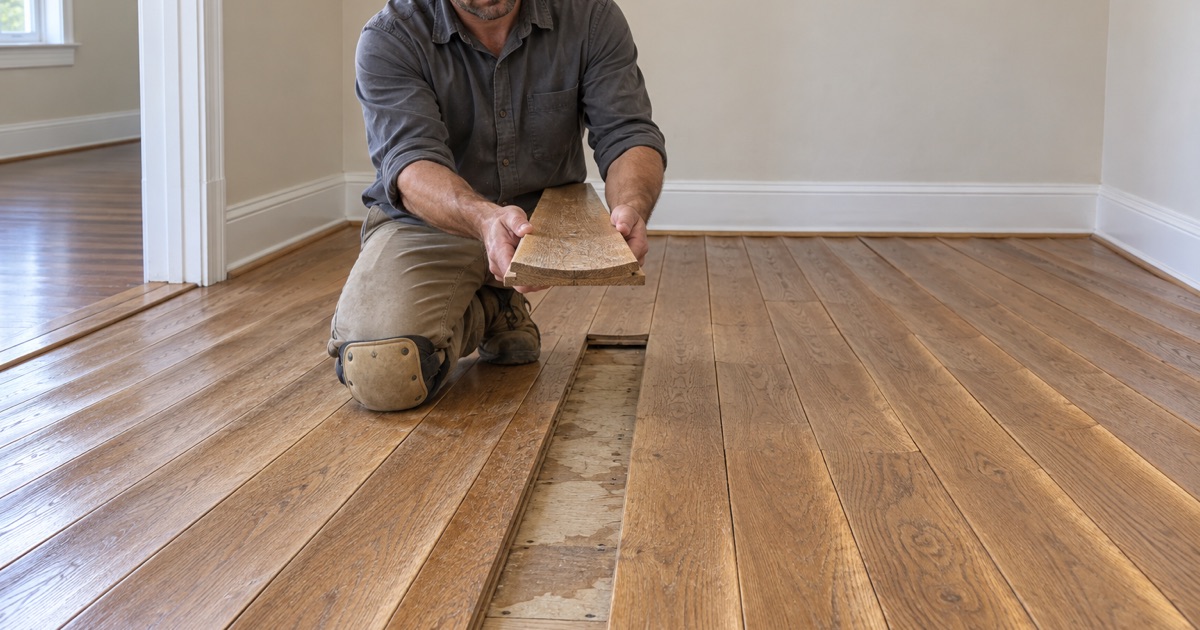
Boards that cupped and recovered, with sound tongues and no delamination, are usually keepers. Boards that buckled, split, delaminated at the wear layer or went black with oxidized tannins generally are not. We mark the field rather than estimating a percentage, because a claim scope built on a count of actual boards holds up and a scope built on a round number does not.
What a Claim Actually Covers
Coverage A and the Dwelling
A floor attached to the structure is part of the dwelling, which is Coverage A in a standard homeowner policy, while the contents that sat on it fall elsewhere. That distinction determines which limit the flooring comes out of and what deductible applies. Knowing it in advance changes how the scope is presented, and it is worth reading your declarations page before the adjuster’s visit rather than after it.
Sudden and Accidental Against the Gradual Leak Exclusion
A burst supply line, a failed appliance hose or a water heater letting go are sudden and accidental events. A slow drip that ran for months behind a cabinet is usually excluded as gradual. This is the distinction most flooring claims turn on, and it gets decided from staining patterns, subfloor condition and moisture distribution. Our documentation is built to show which of the two the physical evidence describes.
Actual Cash Value Against Replacement Cost
Replacement cost pays to put the floor back; actual cash value pays that less depreciation for the age and condition of what was lost. Which applies is written into the policy before the loss, not negotiated after it, and on a twenty-year-old floor the difference can be substantial. We scope the work the same way either way, so the estimate is comparable to whatever the carrier produces.
Continuous Flooring and How Far Replacement Runs
Line of Sight and Unbroken Runs
Where the same floor runs through an open doorway with no threshold into a dry room, the two areas are hard to separate visually and harder to separate in a scope. Where a T-mold, threshold or change of material divides them, they separate cleanly. Line of sight is the term for that argument, and establishing it accurately is usually the biggest number in a flooring claim.
The Line-of-Sight Map
We draw it: which rooms the flooring runs into unbroken, where every transition sits, what is visible from where, and the dated moisture readings tied to each area. A written map that anyone can walk and verify is a far stronger document than a description, and it removes the part of the conversation that would otherwise be two people remembering the house differently.
Matching Against Replacing
Where the field is repairable, we lace new boards into it and sand the whole area as one continuous surface so the repair disappears. Where the floor is prefinished, discontinued, or too far gone to blend, matching becomes the wrong goal and we say so. An honest replacement scope is better for a claim than a match nobody believes will read as one floor.
Our Step-by-Step Water Damage Repair Process
Step 1: Document Before Anything Moves
Room-by-room photographs, dated moisture readings from boards and subfloor, and a line-of-sight map recording every unbroken run and every transition in the affected area. None of that can be reconstructed once the room has been cleared, which is why it happens first.
Step 2: Confirm the Source Is Repaired
Work does not start over an unrepaired leak. On slab leaks that means the plumbing repair and its pressure test; on supply failures it means the fitting or appliance is genuinely done.
Step 3: Dry and Verify
The assembly is dried, and we meter until the readings stabilize rather than until the deadline arrives. Concrete gets tested as a slab, not judged by touch.
Step 4: Scope the Repair Against the Claim
Boards to save and boards to lose are marked individually, the subfloor is assessed for panel replacement, and the scope is written in line items that map onto the carrier’s estimate.
Step 5: Rebuild, Blend and Hand Over
Boards are laced in or the field replaced, the area is sanded and coated as one surface where the floor is site-finished, and the written cure and occupancy schedule goes to you before the first coat.
- 20+ Years Experience
- Dustless Containment
- Free Written Estimates